Guide
Brand guidelines template: what the document should contain
A brand guidelines document tells anyone reproducing your brand how to do it: the logo in each arrangement, the space around it, how small it can go, the colours it may appear in, how it must not be used, your colour values, your typefaces and your files. Ours is 12 pages of A4 landscape, generated from your own design when you buy a brand kit or a logo template.
Updated
In Australia. Australian printers and signwriters work in millimetres, so the minimum sizes are printed at true size in mm on an A4 page.
| Pages | 12, A4 landscape |
|---|---|
| Resolution | 150dpi |
| Minimum sizes shown | 60mm, 20mm, 10mm, at actual size |
| Colour versions | 4: full colour, reversed, single colour, greyscale |
| Misuse examples | 6 |
| Colour values | HEX, RGB, CMYK |
| Included with | every purchase: the full document with every brand kit ($199) and logo template ($49), a shorter one with templates that have no logo |
The sections a small business guidelines document needs, in the order they run, with pages from one of ours.
What is a brand guidelines document for?
It writes down how your logo and colours are used, so a supplier can follow the decisions without a conversation. Every logo comes with decisions about how it is used: which version goes where, how much room it gets, what colour it may be printed in and what it must never look like. A guidelines document writes those decisions down so a printer, a signwriter, a web developer or a new staff member can follow them without a conversation.
For a small business the useful version is short. It needs to answer the questions suppliers ask, and it needs to be something you will forward rather than file.
What should a brand guidelines document contain?
It should cover the logo and its variants, clear space, minimum sizes, colour versions, misuse, the palette, the typefaces and the files. Ours runs to 12 pages, in this order: what the identity is, the logo large, its variants, how to protect it, how small it may go, how it may be coloured, how it may not be used, then the specifications and an index.
- Cover. The business name and the primary lockup, set as the document's title.
- The idea. One paragraph stating what the identity is and who it is for, so anybody picking the document up knows what they are protecting.
- Primary lockup. The main arrangement of the logo, large, on its own.
- Variants. The other arrangements, such as a stacked version and a monogram, for places where the primary lockup will not fit.
- Clearspace. The space the logo needs around it, drawn around the real lockup: at least one x-height on every side, with nothing inside it.
- Minimum sizes. The logo at 60mm, 20mm and 10mm, set at actual size so the page can be printed and checked by eye. Below the smallest size the monogram takes over.
- Colourways. The 4 versions the logo may appear in: full colour, reversed, single colour and greyscale. Anything else is a misuse.
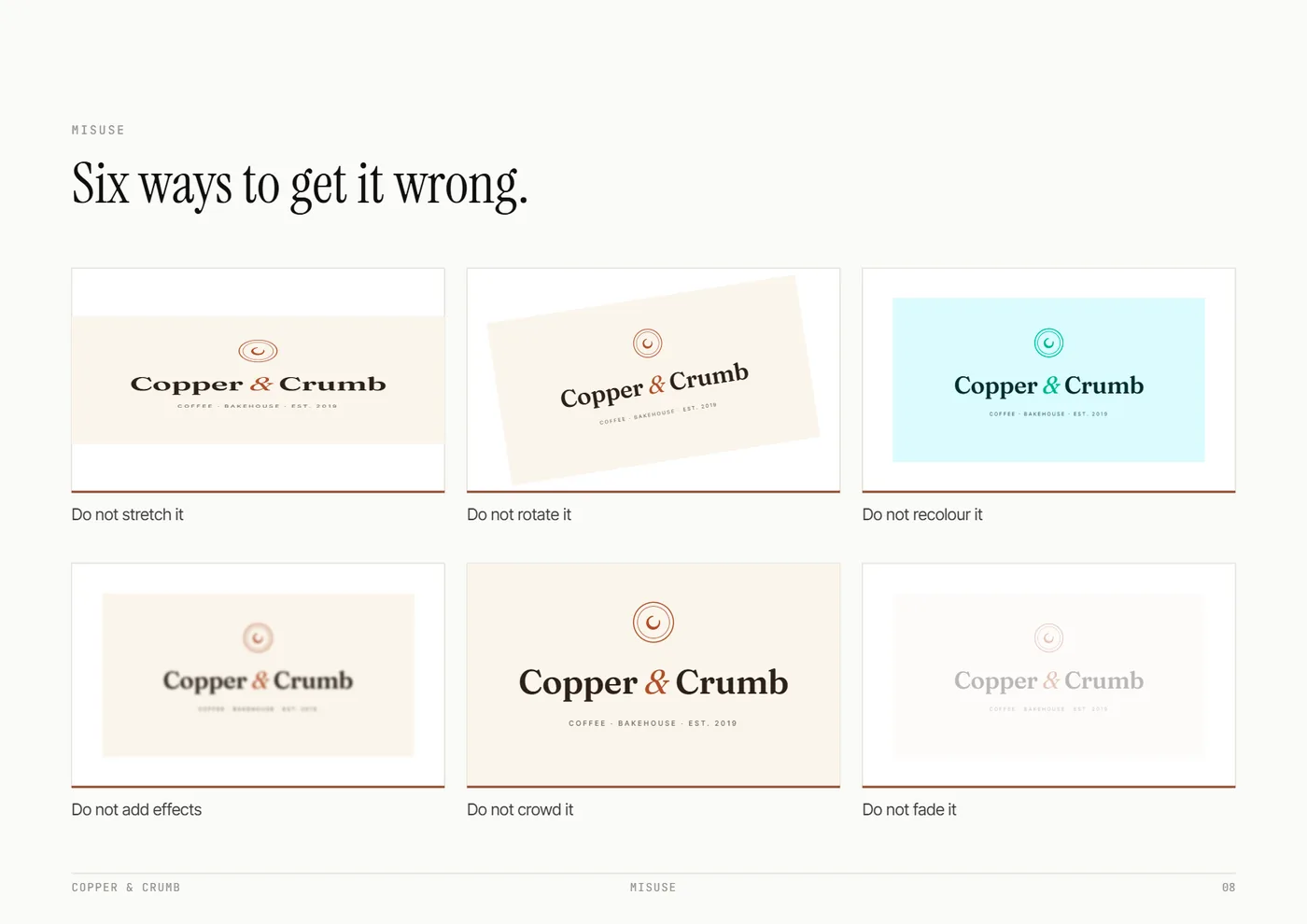
- Misuse. 6 wrong versions of your own lockup, drawn rather than described, each with the rule it breaks: stretch it, rotate it, recolour it, add effects, crowd it and fade it.
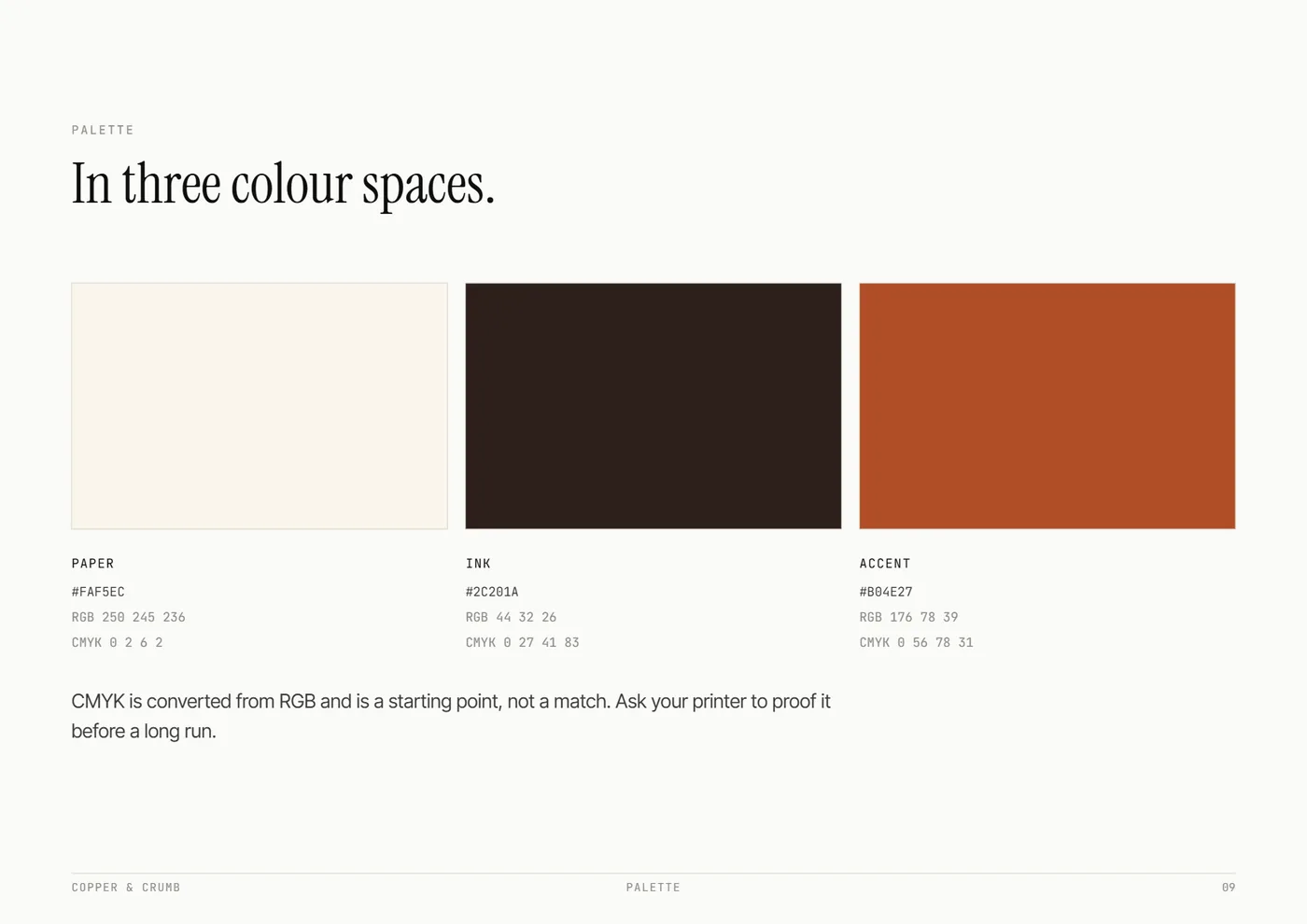
- Palette. Every brand colour as a swatch with its values in HEX, RGB and CMYK. The CMYK figures are a conversion and the page says so: a starting point for your printer, not a match.
- Typography. Each typeface the identity is set in, with a specimen line and the full character set, and where it is licensed from.
- Pattern. Your mark repeated as a pattern that tiles without a visible join, at fine, regular and bold scale, for packaging, backgrounds and anything that needs texture.
- File index. Every file in the download, listed by name, so the document and the folder can be checked against each other.
Which pages do suppliers use most?
Minimum sizes, palette and misuse. Minimum sizes is the page to hand an embroiderer or a sign writer. It is set at actual size on an A4 page, so printed at one hundred percent the marks measure what their captions say.
Palette is the page a printer and a web developer both need. It gives the colours as values rather than names, so a printer matches a value instead of working from a description.
Misuse shows your own logo stretched, recoloured and crowded, each with the rule it breaks. It is quicker to take in than a written list of rules.
Which page should each supplier see?
Send the whole document with the files, and name the page that answers the question being asked.
- A commercial printer: palette, for the colour values, and the file index, for the print-ready files.
- A signwriter: minimum sizes, clearspace and colourways, which together say how big, how much room and in which colours.
- An embroiderer: minimum sizes, and the single colour version on the colourways page.
- A web developer: palette, typography and the file index.
What does a studio guidelines document add?
A branding studio's document usually adds pages covering tone of voice, photography direction, layout grids, signage systems and packaging. Those matter to a business with a marketing team or several locations. Ours does not include them. It covers the identity itself: the logo, its colours, its type and its files.
How is the BrandLaunch guidelines document made?
The document is generated from the same artwork you edit in the browser, at the moment you download it. The lockups on every page are your own, with your business name in them. The palette values are computed from the colours you chose, and the typefaces are the ones your design is set in.
The pages are rendered at 150dpi, which is sharp on screen and prints cleanly on an office printer. The minimum-size page prints at true size.
Which BrandLaunch purchases include a guidelines document?
Every purchase does, and what it contains depends on what the template has. Every brand kit and every logo template gets the full 12 page document above: there are 51 kits at $199, which add stationery, social artwork and a website page to the logo, and 82 logo templates from $49.
A template with no logo, such as a business card, a social pack or a menu, gets a shorter document of up to 7 pages built from what it does have: cover, the idea, the artboards, palette, typography, pattern and file index. It has no lockup, clearspace or minimum-size pages, because there is no logo to show on them. The document is not sold on its own.
If you already have a logo and need it redrawn into production files instead, that is a separate service.
Common questions
What should brand guidelines include?
The logo and its other arrangements, the clear space around it, its minimum size, the colour versions it may appear in, examples of misuse, the brand colours as exact values, the typefaces, and a list of the files. Larger documents add tone of voice, photography and layout rules.
How many pages should brand guidelines be?
There is no set length. It should be long enough to answer what suppliers ask and short enough that people read it. Ours is 12 pages covering the identity itself; studio documents that add tone of voice and photography direction run longer.
Does a small business need brand guidelines?
Once anybody other than you produces anything with your logo on it, yes. A printer, a signwriter or an embroiderer will otherwise guess at your colours, your spacing and how small the logo can go.
Is there a brand guidelines template I can fill in?
Ours is not a blank template to fill in. The document is generated from the design you make, so every page already shows your own logo or artwork, colours and typefaces when you download it.
Templates mentioned here
Written by BrandLaunch.